 Save
Save My sister called me three days before Easter asking if I could bring something special—nothing store-bought, she said with that specific tone that meant she'd already imagined what she wanted. A pie with whole eggs visible inside, she said vaguely, something that looked impressive but didn't require me to fuss all morning. That's when this Italian Easter pie came to mind, the kind with creamy ricotta, ham, and those beautiful hard-boiled eggs arranged like a secret waiting to be discovered when you slice into it. I'd watched my aunt make something similar years ago, though I'd never actually tried it myself, and suddenly I wanted to understand why it had stuck with me so clearly.
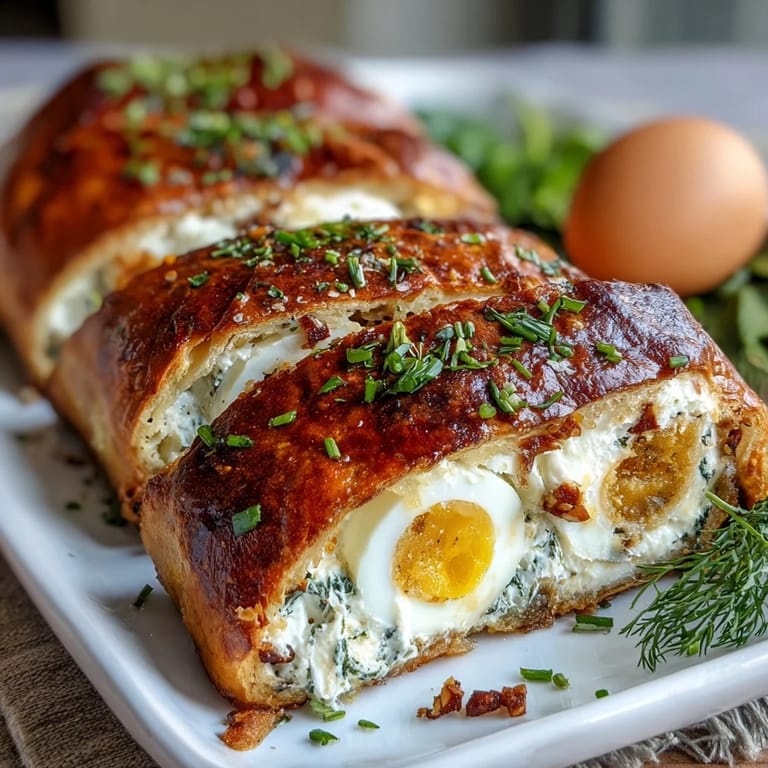
That first Easter making this pie, I was genuinely nervous about the egg placement—would they stay centered, would they crack, would the whole thing hold together? I remember standing there with the ricotta mixture on my hands, thinking about how my sister had a specific way of settling into our kitchen when she was about to taste something new, that slight forward lean like she was bracing for disappointment and hoping not to find it. When we sliced into that pie and those eggs appeared in their perfect line, the whole room went quiet for a second, and then everyone laughed because it felt like such a small magic trick.
Ingredients
- Puff pastry (2 sheets, about 500 g): Make sure these are truly thawed at room temperature, not rushed in the microwave, because you need them flexible enough to press into corners without tearing.
- Ricotta cheese (250 g): The backbone of this filling, and it should be creamy but not watery—if yours looks wet, drain it through cheesecloth for an hour.
- Cooked ham (150 g, diced): Buy it sliced thick enough that you can cut it into actual pieces rather than getting those paper-thin fragments that disappear into the filling.
- Baby spinach (100 g, wilted and chopped): Wilt it yourself in a dry pan so you control how much moisture stays in it, then squeeze it in a clean kitchen towel until it's really dry.
- Grated Parmesan cheese (80 g): Freshly grated makes a real difference here—the pre-grated stuff sometimes has an off taste that shows up in something this simple.
- Large eggs (3 for filling, 4 hard-boiled for center): These eggs are your binder, so they need to be room temperature when you mix them so they incorporate smoothly into the ricotta.
- Ground nutmeg (1/2 tsp): Just a whisper of this—it's what makes people ask what that subtle flavor is, and it's entirely optional if you're not a nutmeg person.
- Black pepper and salt (1/2 tsp each): Taste as you go because you'll need to adjust once the Parmesan is added, as it brings its own saltiness.
- Olive oil (1 tbsp): This keeps the filling from being too dense and helps everything bind together without needing more eggs.
- Egg yolk and milk (for wash): This creates that burnished golden top, though honestly if you don't have milk, water works almost as well.
Tired of Takeout? 🥡
Get 10 meals you can make faster than delivery arrives. Seriously.
One email. No spam. Unsubscribe anytime.
Instructions
- Get your oven ready and prep the pan:
- Heat to 190°C (375°F) and grease your springform or pie pan so thoroughly that you'll forget to worry about the pastry sticking. This matters more than you'd think when you're trying to unmold something this delicate.
- Line with pastry:
- Unroll one sheet of puff pastry and settle it into the pan, letting it overhang slightly at the edges—don't stretch it or it'll shrink back in the oven like it's trying to escape. Press it gently into the corners where the pan curves.
- Mix your filling:
- Combine the ricotta, ham, spinach, Parmesan, three eggs, nutmeg, pepper, salt, and olive oil in a large bowl, stirring until everything is incorporated and smooth. You're not making this look pretty—you're creating a cohesive filling that will hold those center eggs stable.
- Create the foundation:
- Spread half the ricotta mixture evenly over the pastry, smoothing it gently so there are no air pockets but also not compacting it. This is your egg's bed, so it needs to be stable but not dense.
- Nestle those eggs:
- Gently press the four hard-boiled eggs into the filling in a line, creating shallow grooves first with your fingers if needed. They should sit snugly but not with force—you're cradling them, not burying them.
- Cover with the remaining filling:
- Smooth the second half of the ricotta mixture over the eggs, using a spatula to create an even surface. Press gently to seal everything, but again, don't compact it too much or your pie will feel heavy.
- Top with the second pastry sheet:
- Place the second puff pastry sheet on top and trim away the excess, leaving about 2 cm beyond the pan edge. Press the edges together with your fingers or a fork to seal, creating a decorative crimp if you're feeling it.
- Add the egg wash and steam vents:
- Whisk together the egg yolk and milk, then brush generously over the pastry top—this creates that mahogany finish you want. Cut a few small slits in the top so steam can escape without making the pastry soggy.
- Bake until golden:
- Place in the oven for 40 to 45 minutes, watching until the pastry is deeply golden and puffed. If the edges are browning too quickly, you can tent them loosely with foil, but let the top stay exposed so it crisps.
- Cool before cutting:
- This is the hardest part—let it rest at least 20 minutes at room temperature so the filling sets and the eggs stay in place when you slice. Those moments while you're waiting are when people gather around asking if it's ready yet.
 Save
Save There's something about making food that reveals itself when you cut into it—a little ceremony built into the meal itself. When my sister's friends were passing plates around that Easter, everyone waited for the first person to slice theirs, and then there was this collective moment of Oh, look at that. Food doesn't always need to taste revolutionary to make a memory; sometimes it just needs to have been made with thought, and for someone else to notice that you made it with care.
Why This Pie Works for Spring
Easter pies are traditional in Italy specifically because they're sturdy enough to travel and elegant enough for a celebration, but not so heavy that you feel sluggish on a day that's supposed to feel fresh and new. The spinach and herbs keep it bright, the ham adds substance, and the whole hard-boiled eggs are symbolic—new life, beginnings, all that. But honestly, it works because it's the kind of dish that looks like you spent hours in the kitchen when it really only took thoughtful assembly.
Variations and Swaps That Work
If you're not wild about spinach, Swiss chard or even finely chopped kale works beautifully—kale is earthier and holds its texture better if you're making this ahead. Fresh herbs scattered through the ricotta—parsley, basil, even some fresh dill if you're feeling experimental—completely change the flavor profile without changing how the pie actually bakes. You could also add roasted vegetables like sun-dried tomatoes or artichoke hearts, though then you're building a slightly different dish.
Serving and Storage Wisdom
This pie is genuinely delicious at room temperature, which is a gift if you're bringing it somewhere or making it ahead because you don't have to stress about reheating. A simple green salad alongside—something with lemon dressing to cut through the richness—makes it feel complete without needing anything else. Leftover slices keep in the refrigerator for three days, and you can eat them cold straight from the fridge or warm them gently in a low oven.
- If you're transporting this somewhere, let it cool completely before moving it, and transport it in the pan so there's no chance of the filling shifting.
- For a make-ahead strategy, assemble everything the night before and just brush with egg wash and bake the morning of.
- If you want to serve it warm, pull it from the oven and give it those full 20 minutes—I know it's tempting to cut into it sooner, but that rest time is when the filling sets so eggs stay where they should be.
 Save
Save This pie became something I make now whenever someone asks for a dish that feels special, and it's become the thing my sister requests. That's really all you need a recipe to be—something that works, tastes good, and creates a small moment of joy when someone sees what you've made.
Recipe Guide
- → What type of pastry is used for the pie?
Puff pastry sheets are used for a light, flaky crust that crisps beautifully when baked.
- → Can I substitute the spinach with other greens?
Yes, Swiss chard or kale can be used instead of spinach for a similar texture and flavor.
- → How are the hard-boiled eggs incorporated?
Whole hard-boiled eggs are placed horizontally in shallow grooves within the ricotta filling before covering with pastry.
- → What gives the filling its creamy texture?
Ricotta cheese combined with eggs and Parmesan creates a smooth, creamy filling inside the pie.
- → How should I serve the pie?
Serve warm or at room temperature, ideally accompanied by a fresh green salad for a complete meal.
- → What seasoning is added to the filling?
A touch of ground nutmeg, black pepper, and salt enhances the savory flavors without overwhelming the dish.